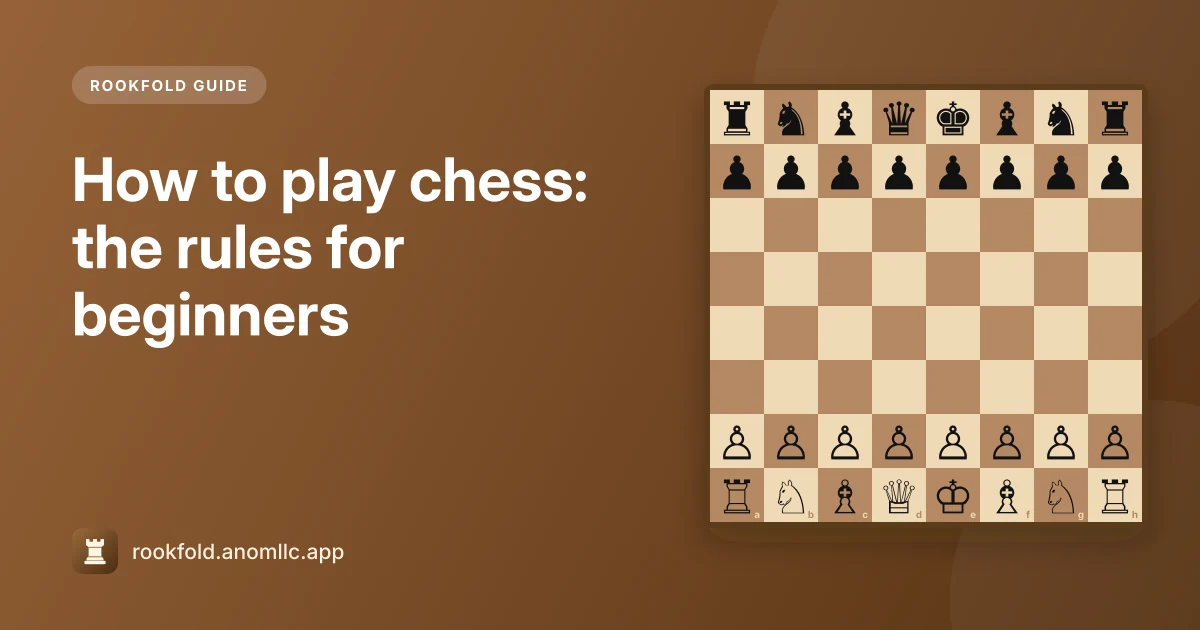
Chess is a game for two players, White and Black, on a board of 64 squares. Each side starts with 16 pieces. You win by checkmating the other king: attacking it so that it has no way to escape. Here are the rules you need for your first game.
The board and the start
The board is placed so that each player has a light square in the right-hand corner. Columns are called files (a to h) and rows are ranks (1 to 8). White starts on ranks 1 and 2, Black on ranks 7 and 8:
- Back row, from the corners in: rook, knight, bishop, then the queen on her own color (white queen on a light square) and the king beside her.
- Front row: eight pawns.
White always moves first, then the players take turns, one move each.
How each piece moves
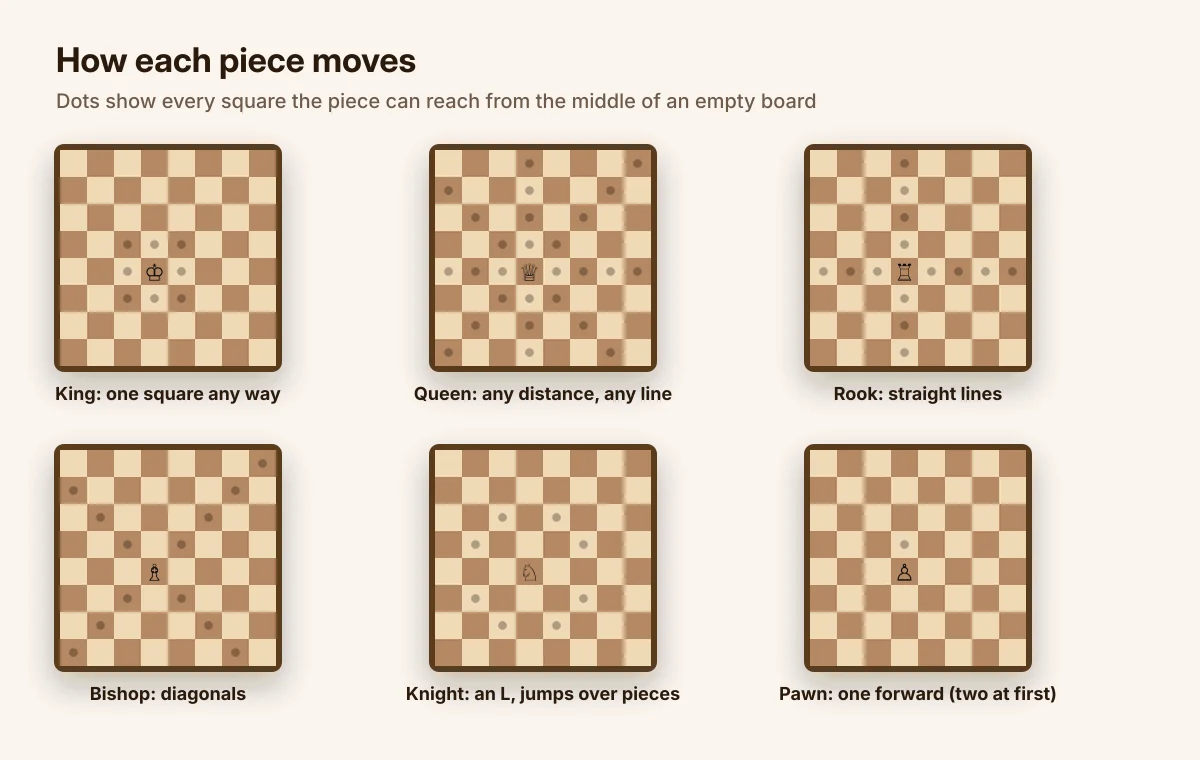
- King: one square in any direction.
- Queen: any number of squares in a straight line: across, up and down, or diagonally.
- Rook: any number of squares across or up and down.
- Bishop: any number of squares diagonally. Each bishop stays on its starting color.
- Knight: in an L: two squares one way, then one square to the side. It's the only piece that jumps over others.
- Pawn: one square straight forward (two on its very first move). It captures diagonally, one square forward to the left or right.
Pieces (except the knight) can't jump over other pieces. You capture by moving onto a square occupied by an opponent's piece, which is removed.
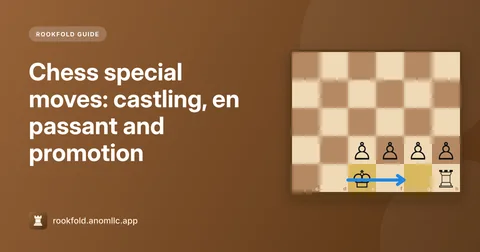
There are three special moves: castling, en passant and promotion. They're explained in our guide to chess special moves.
Check and checkmate
When a king is attacked, it's in check. The player in check must get out of it at once, by:
- moving the king to a safe square,
- capturing the attacking piece, or
- putting a piece in between (not possible against a knight).
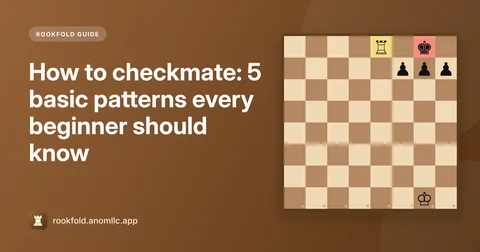
If none of these works, it's checkmate and the game is over. You may never make a move that leaves your own king in check. See how to checkmate for the basic patterns.
How a game can be drawn
- Stalemate: the player to move has no legal move but isn't in check.
- Threefold repetition: the same position occurs three times.
- 50-move rule: 50 moves by each side with no capture and no pawn move.
- Not enough material: neither side has enough pieces left to checkmate (for example, king against king).
- Agreement between the players.
Playing in Rookfold
Tap a piece to see every square it can go to, then tap the square (or drag the piece). You can take back any move and ask for a hint, which shows a strong move with an arrow. The computer has eight levels; the lowest make human-like mistakes so you can win your first games. Read chess tips for beginners when you're ready to improve.